
The Failure of Racial Science
The Glass RoomThis flow traces how the biometric centre’s promise of measurable racial truth collapses under its own contradictions while enabling persecution.
increasing Bearing strength in each event
 decreasing
Bearing strength in each eventdecreasingThe Promise of Measurement

Numbers Offered as Certainty
A scientific façade
Researchers collect measurements, photographs, blood groups, and biographical information in the Landauer House. The methods appear standardized and objective.
The centre claims that careful data can disclose meaningful racial categories.
Ideology sets the question
The research begins from the political assumption that races are distinct and hierarchically ranked. Measurement is used to serve a conclusion already desired by the state.
The Individual Becomes a Type
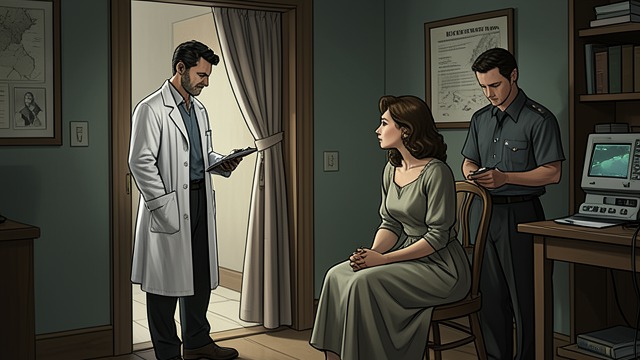
A Person Reduced to Data
The procedure
Subjects answer questions and submit to measurements, medical tests, and photographs. The staff asks them to trust a process whose records may travel far beyond the examination room.
Their bodies are described in exact terms, yet the documentation cannot capture their histories or relationships.
Classification’s violence
The scientific setting masks the coercion of being examined and categorized. The body becomes evidence for a system that treats some people as more human than others.
A Scientist’s Uncertainty

Limits the Regime Rejects
No single distinguishing trait
Stahl admits that researchers have no single physical characteristic capable of identifying a Jew. He presents combinations of traits as a possible route, but cannot provide a definitive answer.
The uncertainty reveals the weakness of the project’s central scientific claim.
Political impatience
Heydrich urges the researchers to hurry because classification is a priority. The regime’s demand does not follow evidence; it pressures science to validate policy.
Data and Contradiction

Accumulation Is Not Proof
Records multiply
The centre processes thousands of subjects and sends punched cards to larger machines. The scale creates an impression of authority, even as each entry remains an inadequate basis for racial judgment.
The system turns human variation into sortable information.
The missing essence
Stahl recognizes that no form records the essence of a person. The novel repeatedly places intimate individuality against the bureaucratic fantasy that identity can be completely captured.
Closure Without Justice

A Failed Project, a Successful Harm
The research ends
Officials close the biometric centre because it has not produced the clear distinctions they expect. The researchers leave and the records and equipment are transferred elsewhere.
The failure of the research does not mean the persecution has stopped.
A broader warning
The centre shows that false science can still serve a political purpose even when its claims are incoherent. The costs are borne by the people the system targets, not by the researchers who designed it.
When the Nazi research centre is established
During the examinations of local subjects
During Heydrich’s inspection
During the centre’s work with files and punched cards
When the Reichsprotektor’s office closes the centre
